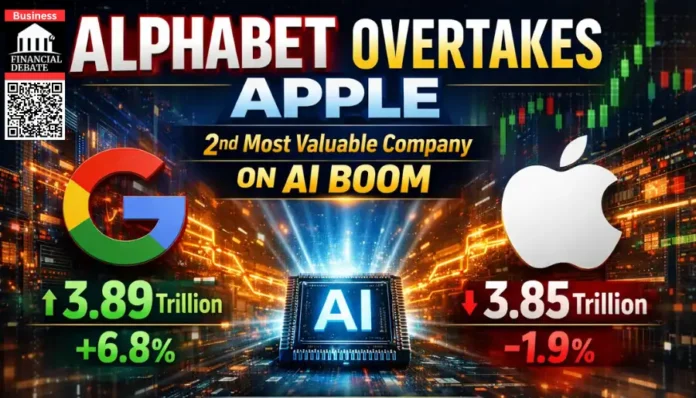
Alphabet market cap surpasses Apple’s for the first time since 2019, hitting $3.89 trillion on AI infrastructure dominance and Asia regulatory headwinds for rivals.
Alphabet Topples Apple to Reclaim No. 2 Spot as AI Bet Pays Off
Alphabet Inc. surpassed Apple Inc. in market capitalization on Friday, unseating the iPhone maker as the world’s second-most valuable company for the first time since 2019. The reshuffling of the “Magnificent Seven” hierarchy underscores a decisive market rotation from hardware-centric incumbents to firms controlling the backbone of the artificial intelligence economy.
Shares of Alphabet rallied 2.4% in New York trading to close at $321.98, propelling the Google parent to a valuation of approximately $3.89 trillion*. Apple shares slid 0.8% to $260.33, leaving its market capitalization at *$3.85 trillion. The divergence widens the gap behind industry leader Nvidia Corp., whose semiconductor dominance continues to anchor the global equity market.
The valuation flip follows a landmark week for Alphabet, driven by the commercial deployment of its seventh-generation “Ironwood” Tensor Processing Units (TPUs) and a surge in enterprise cloud bookings. Conversely, Apple faces deepening regulatory headwinds in Asian markets and investor fatigue over delays to its generative AI suite, Apple Intelligence.
The AI Infrastructure Premium
Investors are aggressively repricing Alphabet not merely as an advertising giant, but as a vertically integrated AI infrastructure sovereign. The company’s ability to reduce reliance on third-party silicon through its custom Ironwood chips has preserved margins even as capital expenditures soar.
“The market is voting on gross margin durability,” said Sarah Yen, a senior equity strategist at Morgan Stanley. “Alphabet’s proprietary TPU stack allows them to train Gemini 3 models at a fraction of the cost of competitors relying solely on merchant silicon. We are seeing the ‘AI utility’ premium materialize in the stock price.”
Data released earlier this week showed Google Cloud’s backlog swelled to a record $155 billion in the fourth quarter of 2025, a 34% year-over-year increase. The growth is fueled by multi-year contracts with Fortune 500 firms integrating Gemini 3 directly into their operational workflows.
Regulatory Headwinds in Asia
While Alphabet surges on infrastructure monetization, Apple and Meta Platforms Inc. are navigating a deteriorating regulatory environment in key Asian growth markets.
Sources familiar with the matter told Bloomberg that regulators in Beijing and Jakarta are finalizing new frameworks this month that would severely restrict cross-border technology acquisitions. The move targets the expansion strategies of U.S. hardware and social media platforms, specifically impacting Apple’s ability to acquire local AI startups to bolster its Siri ecosystem.
“The regulatory wall in Asia is getting higher,” notes Rajiv Sethi, an analyst at Wedbush Securities. “Apple’s strategy of ‘acquihiring’ talent to fix its AI deficit is hitting a blockade in the very markets where it needs growth the most. The recent iPhone 16 sales ban in Indonesia was just the opening salvo.”
Meta is similarly exposed, with its proposed acquisition of a Vietnam-based gaming studio reportedly stalled by antitrust officials citing data sovereignty concerns.
By The Numbers: The New Pecking Order
Mega-Cap Tech Snapshot (YTD)
| Company | Market Cap (USD) | YTD Performance | Primary Growth Driver / Risk |
|---|---|---|---|
| NVIDIA | ~$4.20T | +5.2% | Blackwell Ultra AI demand |
| Alphabet | ~$3.89T | +6.8% | Cloud growth & TPU margins |
| Apple | ~$3.85T | −1.9% | Asia regulatory risk, Siri delays |
| Microsoft | ~$3.65T | +1.1% | Copilot adoption plateau |
Apple’s ‘Siri 2.0’ Delays
The sentiment shift was exacerbated by reports on Thursday that Apple has internally pushed the full rollout of its next-generation voice assistant, colloquially dubbed “Siri 2.0,” to late 2026. The delay leaves the iPhone 17 hardware cycle without a flagship AI differentiator at launch, raising concerns about a “supercycle” that may fail to materialize.
“Hardware is entering a deflationary period relative to software infrastructure,” said Yen. “Until Apple proves it can monetize AI services at the same velocity as Google Cloud, the valuation gap is likely to persist.”
Market Reaction: ETFs and Derivatives
The reshuffling triggered significant rebalancing flows in passive instruments. Technology-heavy ETFs, including the Invesco QQQ Trust (QQQ), saw volumes spike in after-hours trading as funds adjusted weightings to reflect Alphabet’s ascendancy.
Options markets are pricing in continued volatility. Implied volatility on Apple puts expiring in March has risen to the 85th percentile, suggesting traders are hedging against further downside if China’s smartphone shipment data, due next week, disappoints.
Key Questions on the Alphabet-Apple Valuation Shift
Why did Alphabet overtake Apple now?
The primary catalyst is the divergence in AI monetization. Alphabet’s Google Cloud is generating immediate, high-margin revenue from its AI infrastructure (TPUs and Gemini models). In contrast, Apple’s revenue remains tied to hardware cycles, which are slowing due to market saturation and a lack of immediate AI-driven upgrade incentives.
What is the ‘Ironwood’ TPU and why does it matter?
‘Ironwood’ is Alphabet’s 7th-generation custom silicon chip designed specifically for training and running AI models. By using its own chips instead of buying expensive NVIDIA GPUs for every task, Alphabet significantly lowers its operational costs, boosting profit margins in a way competitors like Microsoft and Meta (who rely more heavily on external chips) struggle to match.
How are Asian regulations affecting Apple?
Regulators in markets like China and Indonesia are enforcing stricter rules on data security and cross-border M&A. This hampers Apple’s ability to acquire Asian AI startups to improve its technology and limits its service revenue growth in these regions. The recent blockage of iPhone 16 sales in Indonesia over local content requirements is a prime example of this friction.
Is NVIDIA still the most valuable company?
Yes. As of January 10, 2026, NVIDIA remains the world’s most valuable company, with a market capitalization exceeding $4 trillion. Its GPUs remain the industry standard for AI training, placing it upstream of both Alphabet and Apple.
Will Apple reclaim the No. 2 spot?
It is possible, but analysts suggest it depends on the execution of its AI strategy. If the delayed “Siri 2.0” update in late 2026 drives a massive iPhone upgrade cycle, Apple could regain the lead. However, unless it solves its regulatory challenges in Asia and demonstrates clear AI monetization, the stock may lag behind infrastructure-focused peers.
What does this mean for the ‘Magnificent Seven’?
The hierarchy is fracturing into two tiers: the “AI Infrastructure” tier (NVIDIA, Alphabet, Microsoft), which is seeing compounding growth, and the “Consumer/Hardware” tier (Apple, Tesla), which faces cyclical headwinds. Investors are increasingly allocating capital based on compute capacity rather than installed user base.