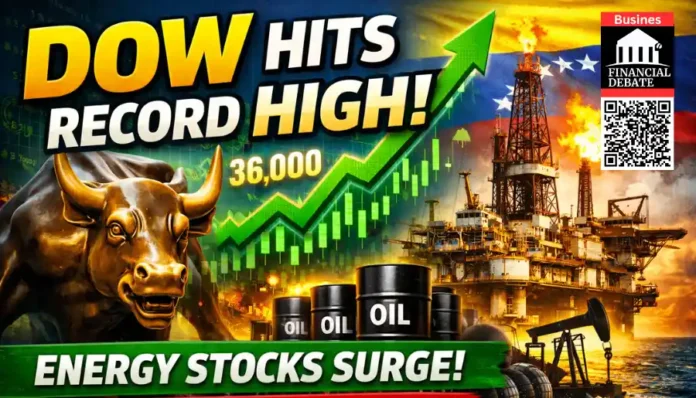
Dow Jones breaks 48,977 record as Chevron and ExxonMobil rally on US military operation in Venezuela. Analysis of the Maduro raid, oil supply shifts, and market impact.
Dow Eclipses 48,900 as Energy Giants Lead Rally on ‘New Venezuela’ Bet
By Jonathan Ferrell and Alix Steel
The Dow Jones Industrial Average surged to a historic peak of 48,977.18 in Tuesday trading, propelled by a violent rotation into energy heavyweights following the stunning US military operation that dismantled the Nicolás Maduro regime in Venezuela this weekend.
Investors are aggressively pricing in a new era of American dominance over the world’s largest proven oil reserves. Chevron Corp. (CVX) and ExxonMobil Corp. (XOM) led the charge, rallying 4.2% and 3.8% respectively, as the White House signaled that US supermajors would be the primary architects of Venezuela’s economic reconstruction. The unprecedented raid, carried out by US Special Forces under the banner of Operation Southern Spear, has effectively reset the geopolitical risk premium in the Western Hemisphere, sending ripples through global crude markets and sovereign bond yields.
“The market is looking past the immediate chaos in Caracas and seeing a medium-term supply bonanza for US-domiciled majors,” said Ed Yardeni, President of Yardeni Research. “With Maduro extradited and the US explicitly stating it will ‘run’ the energy transition there, the risk discount on Venezuelan assets has effectively vanished overnight.”
Why Are Energy Stocks Rallying Now?
The rally in energy stocks is driven by two converging narratives: immediate security for existing assets and the promise of future expansion.
Chevron, the only US major that maintained active operations in Venezuela under a specific OFAC license renewed in mid-2024, is viewed as the immediate beneficiary. The company currently lifts approximately 150,000 barrels per day (bpd) from its joint ventures with PDVSA. Analysts at Goldman Sachs issued a note early Tuesday upgrading CVX to a “Conviction Buy,” projecting that with US military oversight, Chevron’s output could double to 300,000 bpd within 18 months.
“Chevron has the plumbing in place,” noted Goldman’s chief energy equity strategist Neil Mehta. “While others have to negotiate entry, Chevron just needs to turn the valves. The removal of the Maduro regime eliminates the primary political bottleneck they have faced for a decade.”
ExxonMobil, meanwhile, is surging on a different thesis: regional stability. The US intervention effectively neutralizes the threat Venezuela posed to Guyana’s Essequibo region—home to Exxon’s massive Stabroek block. With the threat of a Venezuelan annexation of Guyana removed, the risk premium on Exxon’s most critical growth asset has collapsed.
What Happened in Operation Southern Spear?
Details emerging from the Pentagon confirm a swift, decapitation strike executed in the early hours of January 3. Elements of the 160th Special Operations Aviation Regiment and Delta Force infiltrated Caracas, securing Maduro and key inner-circle officials before extracting them to US jurisdiction.
The operation was the culmination of months of naval buildup in the Caribbean, involving the USS Gerald R. Ford carrier strike group. While officially framed as a counter-narcotics mission targeting the Cartel of the Suns, the scope of the airstrikes—which degraded Venezuelan air defenses and military command centers—has left a power vacuum the US is moving quickly to fill.
President Trump, speaking from the Oval Office late Monday, declared the operation a “victory for hemispheric safety” and explicitly linked the stabilization of Venezuela to US energy independence. “American companies will fix the mess,” he stated, a comment that lit the fuse for Tuesday’s pre-market rally.
How Does This Impact Global Oil Supply?
The immediate impact on physical oil markets is paradoxical. WTI Crude spiked 2.1% to $78.40 on the initial news of the raid due to uncertainty, but futures curves are flattening.
The “bull case” for stocks is actually a “bear case” for long-term oil prices. If US administration of Venezuela’s energy sector succeeds, it could bring an additional 1-2 million bpd of supply online by 2028. However, in the short term, the market faces a potential supply disruption if loyalist factions in the Venezuelan military sabotage infrastructure.
“The market is betting on a seamless transition, which is historically optimistic,” warned Helima Croft, Head of Global Commodity Strategy at RBC Capital Markets. “Venezuela’s infrastructure is in severe decay. Even with US military protection, turning the Orinoco Belt back into a global powerhouse is a multi-year capital expenditure project, not a switch.”
What Does This Mean for the Guyana Dispute?
For Guyana, and specifically for the consortium led by ExxonMobil and Hess Corp., the US intervention is a decisive game-changer. Throughout 2025, tensions had escalated as Maduro mobilized troops along the Essequibo border, threatening the offshore platforms that drive Guyana’s economic miracle.
With the Maduro regime dismantled, the existential threat to Guyana’s sovereignty—and Exxon’s assets—is considered nullified.
“The geopolitical risk premium for Guyana production has gone to zero,” said Paul Sankey of Sankey Research. “Exxon can now proceed with the Fangtooth and Haimara developments without the shadow of a Venezuelan naval blockade.”
How Are Emerging Markets Reacting?
The shockwaves are being felt well beyond the energy sector. Venezuelan sovereign bonds, which have traded in distressed territory for years (often below 10 cents on the dollar), were suspended from trading in several OTC markets as traders attempted to assess the likelihood of a US-backed debt restructuring.
However, there is significant anxiety regarding China’s reaction. Beijing is Venezuela’s largest creditor, with exposure estimated at over $15 billion. The US seizure of the Venezuelan state apparatus puts these loans in jeopardy. Chinese Foreign Ministry officials on Tuesday condemned the operation as a “flagrant violation of sovereignty,” but market reaction in Asia was muted, suggesting investors believe Beijing may cut a deal to recoup some losses rather than escalate.
What Are the Risks for Investors?
While the Dow is celebrating, strategists caution that the “regime change trade” is fraught with execution risk:
1. Insurgency Risk: Remnants of the Colectivos and loyalist military units could launch an asymmetric campaign against US-operated oil infrastructure, mirroring the challenges seen in post-invasion Iraq.
2. Legal Quagmire: Ownership of PDVSA assets is entangled in international arbitration. Claimants like ConocoPhillips and Crystallex will aggressively pursue their awards now that a US-backed transitional government is likely.
3. Oil Glut: If Venezuelan supply returns faster than expected, it could crash oil prices, hurting the very US shale producers that make up a significant portion of the energy index.
Market Outlook
As of midday in New York, the bullish sentiment remains dominant. The S&P 500 Energy Sector is on track for its best single-day performance since 2022. The broader market view is that the US has secured a strategic energy fortress in its backyard, cementing energy security for the next decade.
“The market hates uncertainty,” concluded Yardeni. “By removing the wild card of Maduro, the US has imposed certainty. Wall Street loves certainty, even if it comes via special forces.”