The bounce is the easy part
Chip stocks rallied overnight after Nvidia’s worst week since 2008. The harder questions, about a scandal, an accounting probe and who is paying for AI’s build-out, are still open
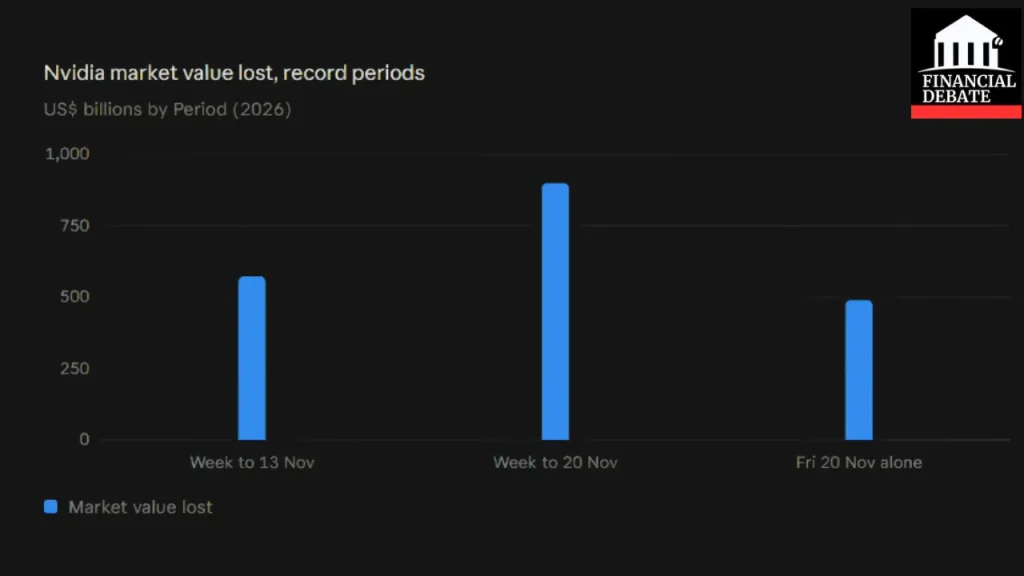
- A record rout, not a rough week: Nvidia lost nearly $900bn of market value in five days, the largest weekly loss for any company on record. It is almost 48% below its October peak, despite reporting sales that more than doubled.
- Good numbers, bad headlines: Quarterly revenue of $115.8bn beat forecasts, and the stock fell anyway. A founder’s exit, an SEC probe and export curbs now outweigh the earnings.
- The bounce is partial: Nasdaq 100 futures rose about 3% overnight, but Korean chipmakers closed lower. Washington’s reported deadline for Nvidia’s answers falls on Wednesday.
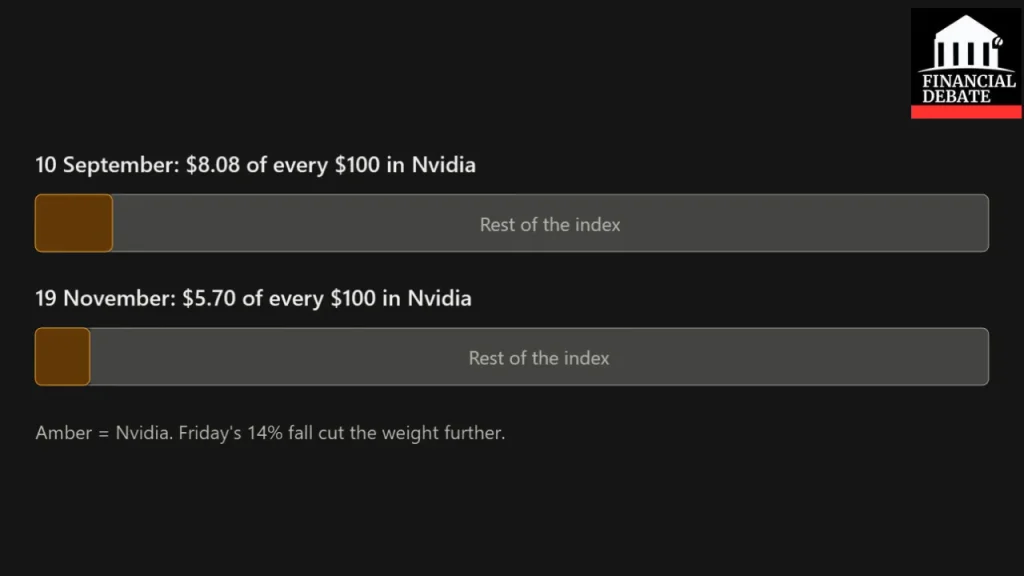
- Your pension is involved: Nvidia was 5.7% of the S&P 500 before Friday’s fall, down from about 8% in September. Index-fund savers own it whether or not they chose to.
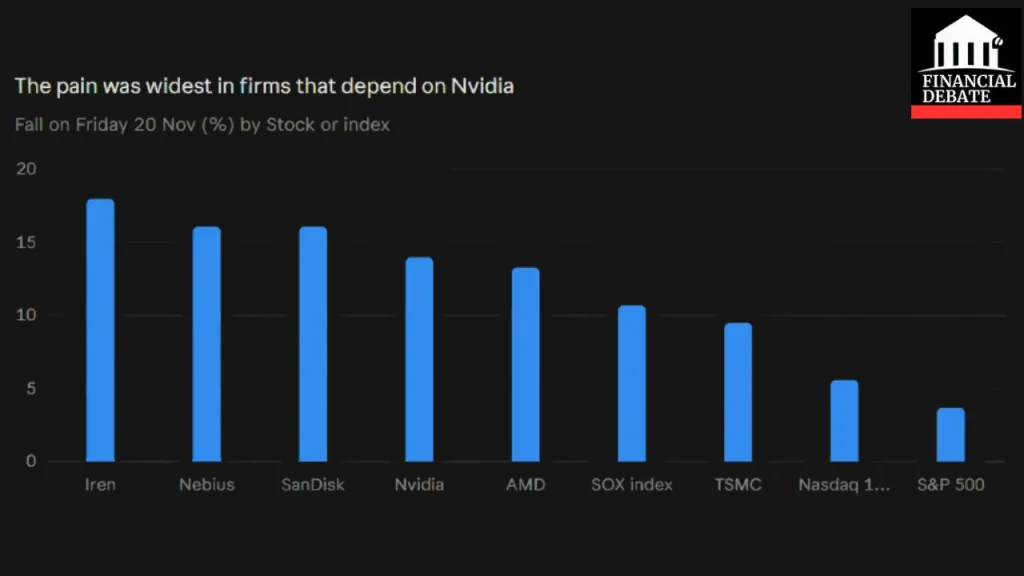
Six weeks ago Nvidia was the world’s most valuable company. On Friday it ranked fourth in America, behind Apple, Microsoft and Alphabet, its shares closing at $125.53 after a 14% one-day fall. The week’s 23% slide was its worst since the 2008 financial crisis, when Lehman Brothers had just collapsed. Then, on Sunday night, the screens turned green. By early Monday, Nasdaq 100 futures were up 2.9% and S&P 500 futures 2.1%.
Is that the bottom, or a pause in a fall that has run for seven straight weeks? The longest such losing run since 2008 matters well beyond Santa Clara. Nvidia sits at the centre of an AI build-out that the four biggest cloud companies have guided at roughly $730bn of capital spending this year. Through index funds, it also sits inside most American pension pots.
The bounce itself is the least interesting part of the story. The harder issue is what kind of problem Nvidia has. If it is a governance problem, with a founder gone and a regulator asking questions, boards and lawyers can fix it. If it is a financing problem, an industry that has borrowed against its own future, only customers’ cash flows can. The evidence so far supports both readings.
A storm in five acts
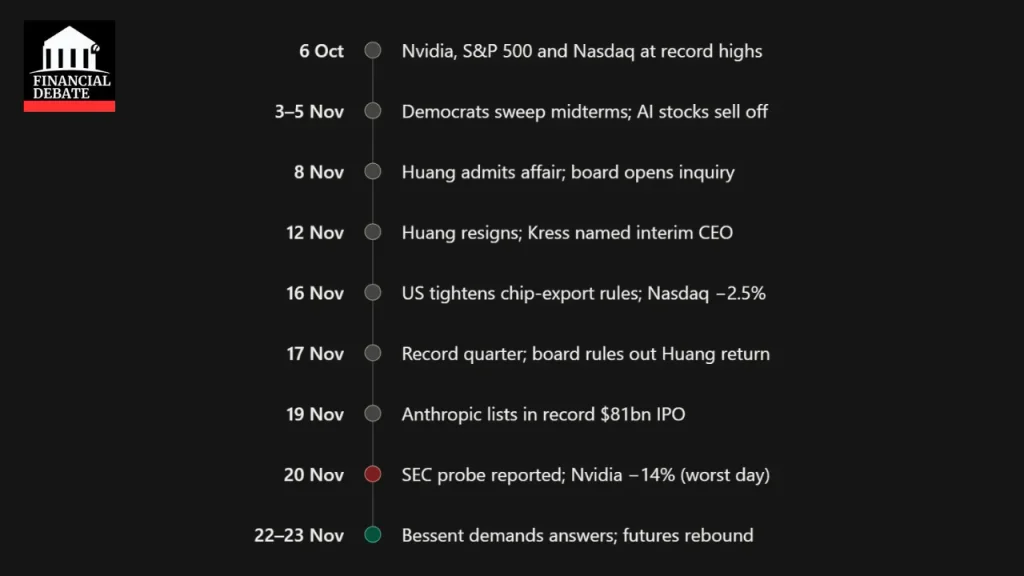
The sell-off did not begin with scandal. Nvidia, the S&P 500 and the Nasdaq all peaked on 6 October. The first blow came after the midterm elections. Democrats won big and some leaders called for restrictions on data centres and the AI build-out. Goldman Sachs said 45% of planned US data-centre capacity was at risk, according to a Reuters report. In Texas, a Democratic governor-elect campaigned on keeping a moratorium on new data-centre construction. Wells Fargo estimates the state holds 27% of planned capacity.
The second blow was personal. On 8 November Nvidia’s board launched an independent investigation into reports that its chief executive was the target of a foreign intelligence effort, and Jensen Huang admitted to an extramarital affair. The woman involved, Alice Huang (no relation), was reported to be a suspected Chinese spy; the Chinese government called the allegations baseless smears. On 12 November Huang resigned as chief executive and director, and finance chief Colette Kress became interim chief executive.
The third came from Commerce, which on 16 November tightened chip-export rules. The fourth was Nvidia’s own earnings on 17 November, when chairman Harvey Jones said the board does not intend to reinstate Huang. The fifth was a pair of events: Anthropic’s record $81.3bn IPO, which failed to lift the mood, and a Reuters report on Friday that the SEC is probing Nvidia’s accounting practices.
The timeline below shows how the pressures stacked up.
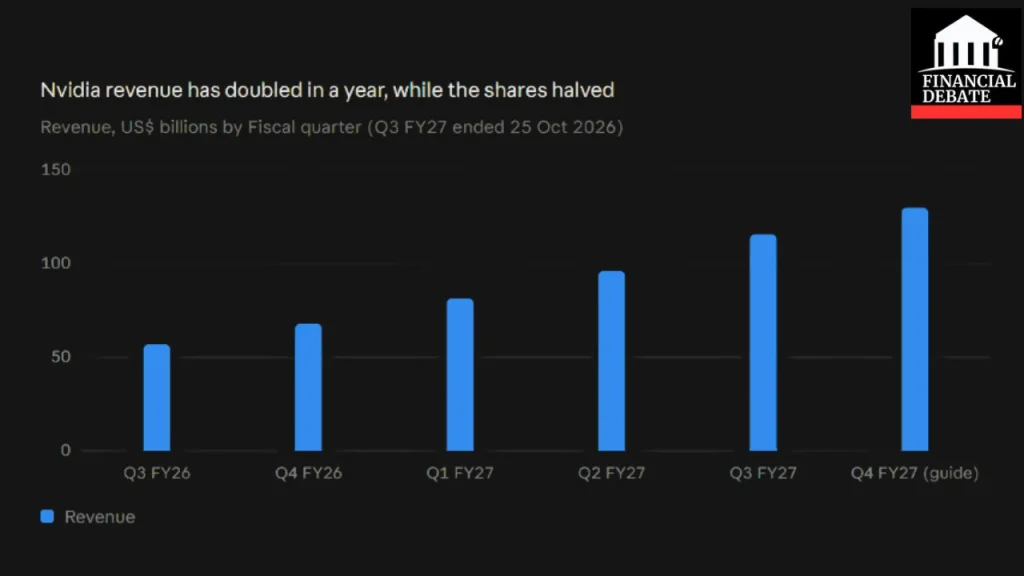
The revenue line shows demand. The share price reflects four pressures that demand cannot answer.
The first is governance and law. The board has ruled out Huang’s return, but Treasury Secretary Scott Bessent said on Sunday that Washington still needs answers about Nvidia’s role in sending AI chips to China, and has reportedly set Wednesday as the deadline for Nvidia to say whether shell companies were used to evade controls. Huang has agreed to testify before the Senate Banking Committee, with House panels due to interview him in early December. California’s attorney general has subpoenaed Nvidia. Reuters reports that SEC staff are scrutinising potential accounting issues, though an investigation does not establish wrongdoing. Megaspeed, the Singapore firm once run by Alice Huang, denies wrongdoing.
The second is export controls. Commerce’s rule of 16 November requires licences for advanced-chip sales to Indonesia, Malaysia, Singapore, Thailand and Brazil, and for data centres that serve Chinese customers above a threshold equal to roughly 760 Nvidia H100 chips. The direct hit looks small. Nvidia’s Hopper shipments to China totalled $2.4bn last quarter, about 2% of sales. Investors are worried about the signal more than the sum.
The third is the politics of power. Donald Trump has threatened a “tremendous tax” on US firms that build data centres abroad, without saying how it would work, and tougher regulation of data centres is expected under Democratic majorities even if he stalls a federal crackdown.
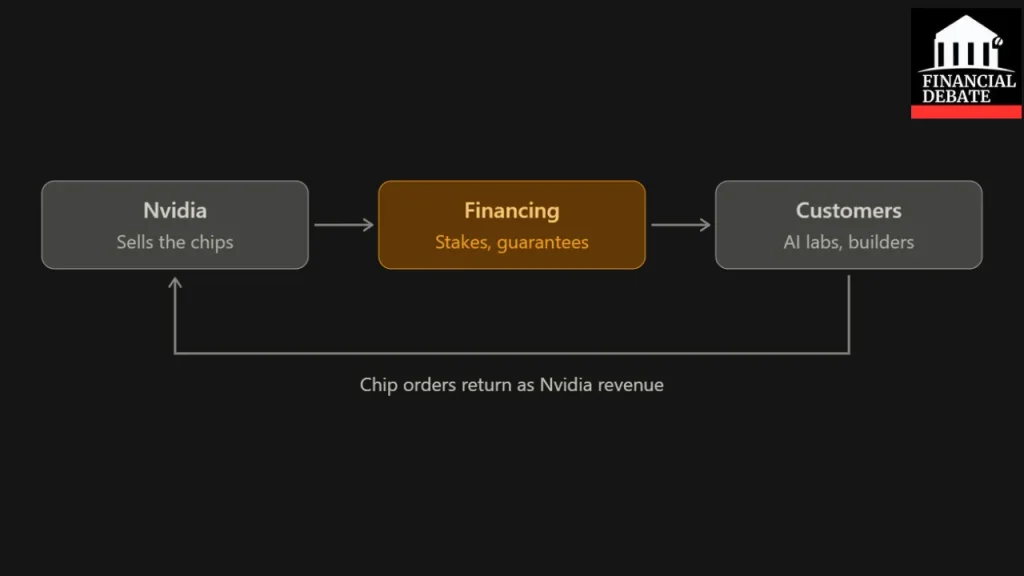
The fourth is money. Futures priced about 92% odds of a Fed rate rise in December, and better than 80% odds of two or more by June. Behind that sits the financing question. Analysts increasingly worry about “circular” deals, in which chipmakers including Nvidia help customers fund chip purchases and data-centre construction. Nvidia said its supply commitments rose to $390bn from $279bn, and that guarantees tied to an Ohio campus leased to OpenAI are capped at $105bn. Interim chief executive Colette Kress told analysts the company would be far more selective about such deals.
The loop that worries sceptics is drawn below.
Bulls, bears and the arithmetic between
The bull case is that the price has overshot. Dan Ives of Yorkville says demand did not leave with Huang, and keeps a $225 target. Goldman Sachs and Citi kept Buy ratings with targets of $220 and $225, and Morgan Stanley trimmed its target to $260 from $267. Valuation helps them. Dealers cited by Dolphin Research note that the forward price-to-earnings ratio of the S&P 500 technology sector fell from 24 to 16 over nine months while expected earnings rose 64%. In the nine months before the 2000 peak, the multiple rose from 34 to 48 while earnings rose only 16%. CNN, citing FactSet, reports the sector at its lowest forward multiple since March 2020 and Nvidia’s at its lowest since 2002. Other tallies differ. FactSet put Nvidia at 11.7 times forward earnings on 12 November, the lowest since 2011, while a Motley Fool writer cites 8 times. The sources do not explain the gap, which presumably reflects different dates and earnings horizons.
The bear case is about what those earnings are made of. Dolphin’s reverse calculation says that at $125, assuming a 15 times multiple and easing margins, the market is pricing fiscal 2029 revenue of about $440bn, less than half the roughly $929bn consensus. If Nvidia’s share of cloud spending holds, that implies hyperscaler capex about 28% lower in 2028 than in 2027, whereas the Street expects 12% growth. In plain words, investors are pricing a peak. The spenders are stretched. One tracker puts the big four’s third-quarter capex at $201.9bn, or 115% of operating cash flow, a secondary source, though other commentary also notes that cash flow has turned negative for some of them.
Rates and flows add pressure. Schwab’s Cooper Howard expects the Fed to hike twice more this cycle. Bank of America strategists say the quickest way to stop the hikes is for the S&P 500 to give back all its 2026 gains, which implies about 6,845, and the index closed Friday at 6,910.39. Trend-following funds sold about $57bn of US equities in a month and are now net short by about $19bn, and models suggest they will keep selling. The same note finds some comfort: 68% of global indices are oversold, and at 88% a contrarian buy signal triggers.
History offers a caution, though a thin one. 24/7 Wall St found that five big stocks whose SEC accounting probes became public were all lower a year later, by 25% to 81%. That is five stocks, picked after the fact. An SEC investigation does not establish wrongdoing, and many close without action.
What to watch
The calendar is crowded. Dell reports on Tuesday, with options implying a move of about 9%. Wednesday brings the reported deadline for Nvidia to tell the administration whether it used shell companies to evade export controls. Huang has agreed to testify before the Senate Banking Committee and will be interviewed by House panels in early December; one report puts a closed-door House session on 1 December. The Fed meets on 8 and 9 December, with a quarter-point rise nearly fully priced and a half-point a minority bet.
The chief-executive question is not closed either. The board has ruled out Huang’s return, but Bessent, pressed on whether Nvidia should look outside for a leader, noted that Huang is now outside the company, and Trump has repeatedly urged his return.
Beneath the headlines, demand indicators disagree. Silicon Data’s index shows B200 rental prices at $6.94 per GPU-hour, up 17% since 14 October, which suggests tight supply. Its token-price index, however, fell 33% since 13 October to $0.65 per million tokens. Cheaper tokens may spur usage, or they may squeeze the revenue each dollar of chips can earn. The data cannot say which.
After the bounce
The bounce tells us little. Rebounds after a 14% one-day fall are routine, and the sellers have not clearly finished. What the next three weeks should settle is which of Nvidia’s two problems the market is pricing. A governance problem has a deadline, a hearing date and a recruiter. A financing problem has none of these. It will show up in cloud budgets, in the yield on chip-backed debt and in lenders’ willingness to underwrite another gigawatt of data centres.
For ordinary savers the lesson is older than AI. An index fund spreads risk across companies, not across ideas, and when one idea reaches 8% of the index the diversification is thinner than it looks.
If Nvidia’s books are clean and its customers keep paying, this will be remembered as a scandal that cost investors a trillion dollars of confidence. If not, it will be remembered as the week the market began asking who was paying for the machines.