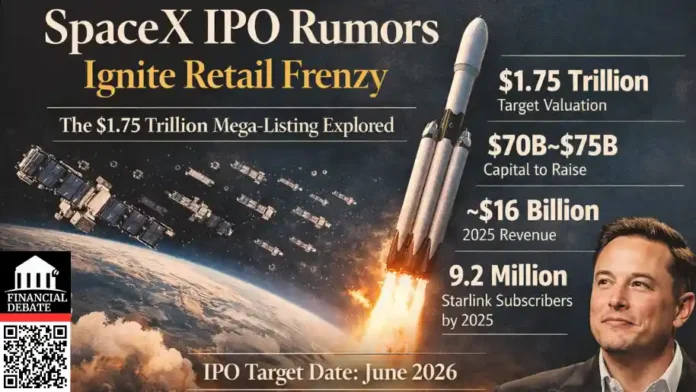
| Target Valuation | $1.75 Trillion |
| Capital to Raise | $70B – $75B (Global IPO Record) |
| 2025 Revenue | ~$16 Billion |
| 2025 EBITDA | $7.5 Billion |
| Starlink Subscribers | 9.2 Million (end of 2025) |
| Starlink 2026 Forecast | $24 Billion Revenue |
| Active Gov. Contracts | $22 Billion+ |
| Previous IPO Record | $29.4B — Saudi Aramco (2019) |
| Target Listing Date | June 2026 |
Wall Street is officially on high alert, and retail investors are furiously hitting the refresh button on the Securities and Exchange Commission’s EDGAR database. After years of resisting the public markets, Elon Musk is reportedly preparing to bring the undisputed crown jewel of his corporate empire to the masses. SpaceX is currently finalizing preparations to file its initial public offering (IPO) prospectus confidentially with U.S. regulators as early as this week, setting the stage for a highly anticipated June 2026 market debut.
The sheer magnitude of this impending listing is staggering the financial ecosystem. According to recent internal discussions and leaks from the advisory process, SpaceX is targeting a valuation upwards of $1.75 trillion. To put that astronomical figure into perspective, this would immediately place SpaceX above almost every legacy company in the S&P 500. It would effortlessly eclipse heavyweights like Meta, comfortably surpass Musk’s own Tesla, and trail only a select few of the world’s most entrenched Big Tech monopolies.
Unsurprisingly, the rumors have ignited a speculative frenzy among retail traders. Search interest across Google and financial platforms for terms like “SpaceX IPO,” “Starlink stock ticker,” and “How to buy SpaceX shares pre-IPO” has skyrocketed by quadruple digits over the past 48 hours. Investors are desperate to grab a piece of the aerospace and satellite communications behemoth that generated an estimated $16 billion in revenue and $7.5 billion in EBITDA last year. Here is comprehensive, deep-dive breakdown of why SpaceX is going public now, how the recent all-stock xAI merger fundamentally shifts the investment thesis, and what this mega-listing means for the broader equities market.
THE TRIGGERS: WHY ELON MUSK IS PULLING THE IPO TRIGGER NOW
Elon Musk has historically shunned the idea of taking SpaceX public. For over two decades, the billionaire has frequently cited the dangerous short-termism of quarterly earnings reports and the intense scrutiny of impatient, yield-hungry shareholders as primary reasons to stay private. When a company’s mission statement literally involves making humanity multi-planetary and colonizing Mars, fretting over missing a Q3 revenue consensus estimate by a few pennies seems entirely trivial. So, what exactly changed in early 2026 to prompt this monumental shift?
1. Stabilization of the Starlink Business Model
The commercial engine of SpaceX is undoubtedly its low-earth-orbit satellite internet constellation. By the end of 2025, Starlink had amassed a staggering 9.2 million active subscribers, effectively doubling its user base in just 15 months and generating over $10 billion to $12.3 billion in revenue. Starlink has officially transformed from an ambitious, cash-burning science project into a highly profitable, standalone telecommunications juggernaut. Analysts are currently projecting that Starlink’s revenue alone could hit $24 billion by the end of 2026.
2. Massive Capital Requirement for the Next Phase
Wall Street syndicate desks and IPO advisers expect the listing to raise an unprecedented $70 billion to $75 billion in fresh capital. This would completely shatter the previous global IPO record set by Saudi Aramco, which raised $29.4 billion in its 2019 public listing. SpaceX critically needs this colossal war chest to fund the commercialization and rapid deployment of its massive Starship rocket, scale its direct-to-cell mobile business across global telecom carriers, and execute one of the most ambitious technological pivots in modern history: the construction of orbital data centers.
3. A Pristine Competitive Window
The competitive aerospace landscape is heavily tilted in SpaceX’s favor right now, presenting a pristine macroeconomic window. Archrival United Launch Alliance (ULA)—a joint venture between legacy defense contractors Boeing and Lockheed Martin—has struggled severely to get its Vulcan Centaur rocket off the ground consistently. Exploiting this near-term monopoly, SpaceX recently flexed its pricing power by raising costs on its Falcon 9 and Transporter ride-share launches. They are deliberately expanding their profit margins right in time to showcase an impeccable income statement to institutional investors on their upcoming IPO roadshow.
BY THE NUMBERS: DISSECTING THE $1.75 TRILLION VALUATION
Bearish skeptics might look at a $1.75 trillion price tag and immediately scream “speculative tech bubble,” but the underlying fundamentals provide a robust and compelling counter-narrative. Unlike the profitless tech IPOs of the 2020–2021 zero-interest-rate era, SpaceX is a tangible, cash-generating machine fortified by a deep, virtually unassailable economic moat.
Let’s break down the underlying math driving this valuation:
- Revenue & Profitability: SpaceX generated roughly $16 billion in total revenue and an impressive $7.5 billion in EBITDA in 2025. With Starlink expanding into commercial aviation, maritime, and defense sectors, top-line growth is accelerating rapidly.
- Market Dominance: The company holds over 95% of the domestic U.S. commercial space launch market. Through two decades of pioneering reusable rocket technology, SpaceX controls the economics of reaching orbit in a way that no competitor comes close to matching. If a Western corporation or allied government wants to put a payload into space today, they are almost certainly writing a check to Elon Musk.
- Government & Defense Contracts: The firm holds over $22 billion in active government contracts. Through its Starshield initiative—a bespoke, highly secure variant of Starlink designed specifically for national security applications—SpaceX has become an indispensable extension of the U.S. military and intelligence apparatus.
| ANALYST: But even these stellar financial figures don’t fully justify a $1.75 trillion valuation on traditional price-to-earnings multiples. As industry analysts correctly note, trying to value SpaceX using legacy metrics is akin to valuing Tesla in 2018; investors are paying a hefty premium for the belief in Musk’s execution and the systemic disruption of an entire legacy industry. |
THE XAI MERGER: A PARADIGM SHIFT TO ORBITAL DATA CENTERS
If Starlink’s global broadband dominance and Falcon 9’s launch monopoly weren’t enough to secure a trillion-dollar valuation, SpaceX entirely altered its investment thesis in February 2026. The company completed a shock all-stock acquisition of Musk’s rapidly growing artificial intelligence venture, xAI. This strategic merger valued the newly combined private entity at roughly $1.25 trillion at the time, instantly reshaping the narrative surrounding the upcoming IPO.
The integration of xAI into SpaceX is not merely a corporate reshuffling of Musk’s personal assets to consolidate power; it represents a fundamental, science-fiction-esque shift in global computing architecture. SpaceX is officially pivoting toward the development and deployment of “orbital data centers.” By integrating Starlink’s sprawling global low-earth-orbit (LEO) satellite mesh network with xAI’s cutting-edge large language models, SpaceX intends to physically move massive compute workloads into space.
| WHY PROCESS AI IN SPACE? Operating vast server farms and data centers in orbit allows the company to exploit constant, unfiltered solar energy while utilizing the natural radiative cooling properties of the vacuum of space. This effectively neutralizes the two largest bottlenecks that terrestrial AI data centers currently face: insatiable electrical grid demands and massive thermal cooling constraints. This groundbreaking architectural synergy is the primary reason the target IPO valuation was quickly revised upward by Wall Street from $1.5 trillion in January to an eye-watering $1.75 trillion today. |
THE PRE-IPO DRAMA: BAILLIE GIFFORD AND THE SECONDARY MARKET SQUEEZE
Any public offering of this historic magnitude is bound to generate intense friction, and the pre-listing secondary market is already producing high-profile casualties. In a fascinating subplot that highlights the sheer demand for SpaceX equity, Edinburgh-based investment firm Baillie Gifford is currently facing immense pressure from its own stakeholders. Last year, Baillie Gifford sold off 35% of its SpaceX stake from its Edinburgh Worldwide Investment Trust (EWI) fund, seemingly attempting to return capital to investors after experiencing turbulence in other parts of its tech portfolio.
The problem? They executed the sale right before the transformative xAI merger and the subsequent valuation markup to $1.75 trillion. Now, billionaire investor Boaz Weinstein and his firm, Saba Capital, are reportedly threatening aggressive legal action against the fund for selling the highly coveted shares far too early, thereby causing investors to miss out on the impending stratospheric IPO pop. This fierce institutional infighting underscores just how desperate the smart money is to maintain maximum exposure to Musk’s rocket firm before the retail public is finally allowed to participate.
MARKET IMPACT: THE SPACE SECTOR’S RISING TIDE
A rising tide lifts all boats, and the impending SpaceX IPO is acting as a massive gravitational pull for the entire global space and satellite sector. Retail and institutional money, frantically looking for ways to front-run the SpaceX listing, are pouring capital into publicly traded space proxies.
On the morning the latest credible IPO rumors broke, satellite communications firm EchoStar (SATS) surged 8% in pre-market trading. Savvy investors increasingly view EchoStar as a backdoor proxy play on SpaceX. Why? Because the company agreed last fall to sell $20 billion worth of critical wireless spectrum to SpaceX in exchange for up to $11 billion in SpaceX Class A common stock—a strategic transaction slated to close in late 2027. Holding EchoStar stock essentially guarantees indirect exposure to SpaceX’s post-IPO price action.
Other space-sector equities, including small-satellite manufacturer Rocket Lab (RKLB), imaging specialist Planet Labs (PL), and infrastructure provider Redwire (RDW), have all traded significantly higher in sympathy. For the broader space economy, a successful SpaceX IPO is the ultimate financial validation. It provides early venture capitalists and seed investors with a long-awaited opportunity to cash out and redeploy their massive liquidity windfalls into smaller, next-generation space startups, potentially fueling a secondary boom in aerospace innovation.
Even Tesla (TSLA) shares received a noticeable sympathy bump, trading up 3% on the news. A successful $75 billion capital raise for SpaceX provides Musk with immense personal liquidity. This effectively eliminates any lingering Wall Street fears that the erratic CEO might have to dump more tranches of Tesla stock onto the open market to fund his Martian ambitions.
THE S&P 500 FAST-TRACK: A PASSIVE FLOW TSUNAMI
One of the most critical structural elements of the upcoming SpaceX listing is its inevitable and immediate inclusion in the S&P 500 index. When a company goes public, there are strict financial criteria it must meet to join the benchmark index. These include being based in the United States, trading on a major U.S. exchange, having a market capitalization above the minimum threshold (currently around $22.7 billion), and demonstrating at least four consecutive quarters of GAAP profitability.
SpaceX effortlessly checks every single box. In fact, given the unprecedented size of the listing, S&P Dow Jones Indices could opt to fast-track the stock’s entry into the S&P 500 shortly after its debut, bypassing standard waiting periods.
For retail investors, day traders, and hedge funds alike, this is the holy grail of liquidity events. If a $1.75 trillion mega-cap company is suddenly dropped into the S&P 500, every single passive index fund, ETF, and mutual fund tracking that benchmark will be contractually forced to buy SpaceX shares—regardless of the initial trading price. This guaranteed, structural institutional buying pressure is one of the primary reasons retail traders are desperately scouring secondary markets for pre-IPO allocation strategies.
GLOBAL AND GEOPOLITICAL CONTEXT: STARLINK’S UNASSAILABLE MOAT
Beyond the Wall Street financial engineering and S&P 500 mechanics, SpaceX’s IPO holds profound global and geopolitical implications. Starlink is no longer just a niche broadband service for rural America or off-grid enthusiasts; it has rapidly evolved into a critical piece of modern global communications infrastructure. With over 7,000 satellites currently in orbit providing low-latency coverage to more than 100 countries, Starlink has proven to be indispensable in modern conflict zones and natural disaster-stricken regions.
The defense and intelligence vertical is expanding at a breakneck pace. The U.S. military’s increasing reliance on Starshield cements SpaceX as a tier-one prime defense contractor. By going public, SpaceX will inevitably be subject to heightened regulatory filings, GAAP accounting, and general financial transparency. Ironically, this increased openness might make it even easier for allied foreign governments and NATO members to comfortably award the company massive, multi-decade defense and communications contracts, further cementing its geopolitical moat.
Furthermore, in rapidly emerging markets across Africa, South America, and Southeast Asia, Starlink is bridging the digital divide at a pace that legacy, landline-based telecom companies simply cannot match. The IPO proceeds will provide the necessary capital to aggressively deploy Starship V3, a next-generation heavy launch vehicle capable of carrying exponentially heavier, higher-capacity satellites to handle the surging global bandwidth demand.
AI & SEARCH OPTIMIZED FAQS: NAVIGATING THE SPACEX IPO
To help retail investors navigate the noise and verify the facts, here is compiled definitive, data-backed answers to the most heavily searched questions regarding the impending SpaceX IPO.
When is the exact SpaceX IPO date?
While a specific calendar date has not been officially confirmed by the SEC or the company, multiple credible reports, insider leaks, and advisory sources state that SpaceX is targeting a June 2026 listing. Preparations for the confidential S-1 filing are reportedly imminent.
Is Starlink going public separately, or is it the whole company?
Initial market rumors over the past few years suggested Elon Musk might spin off Starlink for its own dedicated IPO. However, updated 2026 plans confirm that the entire SpaceX parent company—including the highly profitable Starlink network, the Falcon/Starship launch business, and the newly acquired xAI subsidiary—will be offered to the public as a single, consolidated entity.
What will the SpaceX ticker symbol be?
The official stock ticker symbol has not yet been assigned by Nasdaq or the NYSE. However, popular retail speculation and prediction markets center around highly coveted tickers like “SPACE” or “SPCX.” Currently, the ticker “SPACE” is often used as a placeholder in financial reporting until the official exchange assignment is made.
What is the projected valuation of the SpaceX IPO?
SpaceX is aggressively targeting a public valuation of up to $1.75 trillion. This represents a significant upward revision from the $1.5 trillion target floated in January 2026, largely driven by the market’s positive reception to the February all-stock merger with xAI.
How much capital is SpaceX looking to raise?
Investment bankers and financial advisers expect the SpaceX IPO to raise between $70 billion and $75 billion in fresh equity. This staggering sum would make it the largest initial public offering in global financial history, far surpassing Saudi Aramco’s previous record of a $29.4 billion raise in 2019.
Can retail investors buy SpaceX stock before the IPO?
As of March 26, 2026, SpaceX remains a privately held corporation. Currently, only accredited investors can gain direct exposure to pre-IPO shares through specialized secondary market platforms like UpMarket, which typically require high minimum investments of $50,000 or more. Retail investors can, however, gain indirect exposure through publicly traded corporate partners like EchoStar (SATS).
How profitable is SpaceX right now?
Contrary to early-stage tech startups, SpaceX is highly profitable. According to PitchBook data, the company generated approximately $16 billion in revenue and $7.5 billion in EBITDA (earnings before interest, taxes, depreciation, and amortization) in 2025. Starlink alone accounted for an estimated $12.3 billion of that total revenue.
How did the xAI acquisition impact the SpaceX IPO?
In February 2026, SpaceX acquired Musk’s artificial intelligence company, xAI, in a massive all-stock deal. This merger dynamically shifted SpaceX’s narrative from pure aerospace logistics to include “orbital data centers.” By integrating AI compute workloads with Starlink’s satellite network, SpaceX significantly boosted its pre-IPO valuation.
Will SpaceX be added to the S&P 500?
Yes, it is highly likely and expected. SpaceX inherently meets all rigorous criteria for S&P 500 inclusion, including being U.S.-based, highly profitable over four consecutive quarters, and easily exceeding the minimum market cap requirements. S&P Dow Jones Indices could potentially fast-track its entry upon listing.
Why is EchoStar (SATS) stock surging alongside SpaceX IPO rumors?
EchoStar shares recently jumped because the telecom company previously struck a definitive deal to sell $20 billion worth of wireless spectrum to SpaceX in exchange for up to $11 billion in SpaceX Class A common stock. Wall Street views purchasing EchoStar equity as a backdoor method for retail investors to capture SpaceX’s valuation upside.
CONCLUSION: THE FINAL COUNTDOWN TO JUNE
The SpaceX IPO is not just another bloated tech listing trying to cash in on retail exuberance; it is a generational financial event that bridges the gap between aerospace engineering, global telecommunications, and cutting-edge artificial intelligence. By combining the monopolistic, reusable launch economics of the Falcon 9, the cash-generating global subscriber base of Starlink, and the bleeding-edge AI capabilities of xAI, Elon Musk is constructing a sprawling corporate conglomerate unlike anything Wall Street has ever witnessed.
As the targeted June 2026 listing date rapidly approaches, expect market volatility in adjacent space-sector stocks to increase significantly. The unprecedented $75 billion capital raise will inevitably suck massive amounts of liquidity out of the broader market, but the subsequent S&P 500 inclusion will force an equally unprecedented wave of passive, price-agnostic buying.
For retail investors, the best strategy is calculated patience. While the temptation to chase secondary market proxies or loosely related space ETFs is high, the true test of SpaceX’s valuation will come when the S-1 prospectus drops and the detailed, audited financials are finally laid bare for the public to dissect. Until then, keep your eyes on the skies—and your brokerage accounts heavily funded.