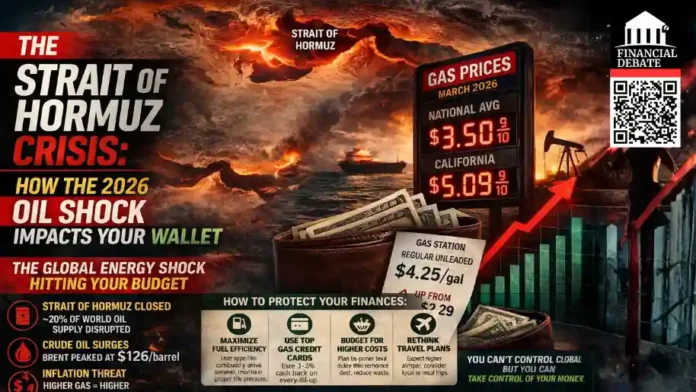
As of late March 2026, American consumers are experiencing intense sticker shock at the gas pump. Following a sudden and severe escalation of conflict in the Middle East, the Strait of Hormuz—the world’s most critical maritime shipping lane for crude oil—has been effectively closed to commercial vessels since February 28, 2026.
If you have noticed a sudden drain on your household budget, you are far from alone. The national average for a gallon of regular unleaded gasoline spiked from a manageable $2.29 in late February to well over $3.50 by mid-March. In select high-cost markets like California, prices quickly blew past the $5 per gallon mark.
At Bankrate, our primary goal is to help you navigate financial uncertainty and maximize your money. This deep-dive feature explores exactly what is happening in the Strait of Hormuz, why a maritime bottleneck half a world away is systematically siphoning money from your wallet, and what actionable steps you can take today to protect your personal finances from the largest global energy disruption in history.
What is the Strait of Hormuz Crisis?
To truly understand the sudden price surge, we have to look closely at the physical geography of the global energy trade. The Strait of Hormuz is a narrow, highly congested waterway—measuring only 24 miles wide at its narrowest point—connecting the oil-rich Persian Gulf to the Gulf of Oman and the broader Arabian Sea.
On February 28, 2026, joint military strikes involving the United States and Israel against Iran ignited a devastating broader conflict. In immediate retaliation, Iran’s Islamic Revolutionary Guard Corps (IRGC) prohibited commercial vessel passage through the strait, backing up their warnings with strikes on merchant ships. By late March, after ceasefire negotiations failed on March 27, maritime traffic dropped to effectively zero, closing the strait to any vessels moving to or from U.S. and allied ports.
Why it matters to your money: Roughly 20 percent of the world’s daily oil supply (equivalent to roughly 21 million barrels per day) and massive, critical volumes of liquefied natural gas (LNG) normally travel through this exact chokepoint. With surrounding terrestrial pipelines offering severely limited bypass capacity, this blockage has stranded millions of barrels of crude oil, creating a profound global energy crisis that experts say dwarfs the 1970s oil shocks.
How High Will Gas Prices Go in 2026?
The most immediate and painful casualty of the Strait of Hormuz blockage is the retail price of gasoline. The U.S. national weekly average surged remarkably fast, jumping more than $1.20 per gallon in a matter of just two weeks.
According to advanced economic projections from the Stanford Institute for Economic Policy Research (SIEPR), the pain at the pump is far from over. Incorporating the latest Wall Street forecasts regarding the prolonged closure of the strait, SIEPR estimates that U.S. retail gas prices could peak at over $4.25 per gallon by May 2026.
For the average American household, this translates to an estimated $857 in additional gasoline costs through the end of the year. This is money that would otherwise go toward savings, debt repayment, or discretionary spending.
The “Rockets and Feathers” Phenomenon
You may be wondering why gas prices shoot up instantly at the first sign of geopolitical conflict but take agonizingly long months to drop after tensions cool. Economists refer to this as the “rockets and feathers” effect. When global crude oil prices spike (the rocket), local gas stations immediately raise their retail prices to cover the anticipated higher replacement cost of their next fuel delivery. However, when crude prices eventually fall, retailers are historically much slower to lower prices (the feather), padding their profit margins until local competition forces them to pass the savings back to you.
Why Does a Middle East Blockage Affect US Fuel Costs?
A very common question we hear at Bankrate is: If the United States produces so much of its own oil domestically, why does a Middle East conflict impact American gas prices so severely?
The answer lies in the fundamental fact that crude oil is a globally traded, highly fungible commodity. Even though only about 7 percent of the oil passing through the Strait of Hormuz is explicitly destined for U.S. shores, the sudden removal of 20 percent of the total global supply creates a massive, panicked scramble.
Countries in Asia and Europe that rely heavily on Middle Eastern oil exports are now forced to aggressively bid up the price of oil from other sources—including the oil produced in Texas, Alaska, and North Dakota. As global demand outstrips the suddenly restricted supply, the price rises for everyone, everywhere.
By the Numbers: The Global Crude Surge
Brent Crude: The international benchmark for oil started the year quietly but shattered the critical $100 per barrel ceiling on March 8, 2026. It reached a staggering, historic peak of $126 per barrel shortly thereafter. As of March 29, 2026, Brent is holding stubbornly near $114 per barrel as markets digest the failure of recent ceasefire talks.
Dubai Crude: Highlighting the extreme stress in the Middle East, Dubai crude prices reached an astonishing $166 per barrel on March 19, their highest level on record.
WTI Crude: The U.S. benchmark (West Texas Intermediate) similarly spiked. The Federal Reserve Bank of Dallas estimates that a two-quarter closure of the strait will raise average WTI prices to $98 per barrel as domestic producers rush to fill the massive global void.
How Does the Crisis Impact the Broader Economy?
The shockwaves of the Strait of Hormuz closure extend far beyond the corner gas station. Oil is the fundamental lifeblood of the modern global economy, and when it becomes wildly expensive, nearly everything else does, too.
1. The Threat of Resurgent Inflation
Just as American consumers and the Federal Reserve were finally seeing sustained relief from the post-pandemic inflation surge, the 2026 energy crisis threatens to viciously reverse that progress. Gregory Daco, chief economist at the consulting firm EY-Parthenon, projected that the sheer volatility and rising oil prices could push March 2026 inflation up by nearly 1 percent over February’s 2.4 percent reading.
This has massive, direct implications for your wallet. Higher inflation means the Federal Reserve is highly unlikely to cut interest rates anytime soon. In fact, Wall Street analysts at Goldman Sachs have already pushed their expectations for the first Fed rate cut from June to September 2026. If you have variable-rate credit card debt or were hoping to secure a significantly lower mortgage rate this spring, the delay will cost you heavily in continued high interest charges. Check our [Latest CD Rates] to see how high yields are holding steady for savers.
2. Rising Grocery and Food Bills
How exactly does a maritime oil crisis make your morning cereal more expensive? The answer is diesel. Diesel is the undeniable workhorse fuel of the American supply chain. It directly powers the heavy tractors that harvest agricultural crops, the massive freight trains that transport bulk goods, and the 18-wheelers that stock your local supermarket shelves.
According to the U.S. Energy Information Administration (EIA), average diesel prices leaped from $3.80 to $4.80 per gallon in early March. Food economics experts at Michigan State University emphatically warn that these elevated transportation costs will inevitably be passed on to consumers at the checkout counter. Furthermore, natural gas is a key ingredient in agricultural fertilizer. The disruption in fertilizer markets threatens to lock in higher food production costs well into 2027.
3. Turbulence for Travel and Airlines
If you are currently planning a summer vacation for 2026, you should prepare immediately for sticker shock. Jet fuel typically accounts for roughly 30 percent of an airline’s total operating costs during normal times. Since the war officially began on February 28, jet fuel prices have surged by approximately 75 percent. Airlines are actively adjusting their fare algorithms upward to protect their margins, making air travel significantly more expensive for families.
What Does This Mean for the Stock and Bond Markets?
The global financial markets utterly despise uncertainty, and the indefinite closure of a critical geopolitical chokepoint delivers systemic uncertainty in spades.
Global Stock Market Volatility: Global equities have taken a massive hit. We’ve seen significant, rapid sell-offs in major indexes as investors weigh the rising risk of stagflation—a toxic economic brew of slowing economic growth combined with high inflation. International markets were severely punished, with South Korea’s KOSPI experiencing its worst crash since the Great Recession. The Dallas Fed noted that a two-quarter closure of the strait could dangerously lower global real GDP growth by an annualized 2.9 percentage points in Q2 2026.
The Energy Sector: The lone, glowing bright spot in the stock market has been the traditional energy sector. Domestic oil producers and natural gas companies have seen their stock valuations surge directly alongside the skyrocketing price of underlying commodities.
Bond Market Sell-offs: As forward-looking inflation expectations rise, bond yields typically follow suit, driving down the value of existing bonds. This dynamic triggered a severe global bond market sell-off, which impacted the UK debt market the worst. If you hold a heavily bond-weighted retirement portfolio, you may see short-term depreciation in your statement balances.
Will Natural Gas and Utilities Become More Expensive?
While the crude oil market is currently seeing immense global contagion, the natural gas market is essentially a tale of two vastly different continents.
Because the Strait of Hormuz is heavily utilized by Qatar—one of the world’s absolute largest exporters of Liquefied Natural Gas (LNG)—European and Asian natural gas prices have skyrocketed into crisis territory. Following the shutdown and strikes on Qatar’s Ras Laffan complex, Dutch TTF gas benchmarks (the standard for Europe) nearly doubled to over €60/MWh by mid-March 2026.
The U.S. Domestic Advantage: Fortunately for American consumers, the domestic natural gas market is largely insulated from this specific overseas shock. The United States produces a massive, sustainable amount of natural gas domestically. According to the EIA’s latest Short-Term Energy Outlook, the U.S. Henry Hub spot price is confidently expected to average a very manageable $3.80 per million British thermal units (MMBtu) throughout 2026. While your home electricity and heating bills shouldn’t see the same violent, immediate spikes as your retail gasoline costs, minor creeping increases are possible if your local utility companies rely on diesel backups or face broader inflationary pressures.
How Are Other Countries Navigating the Crisis?
While U.S. drivers are feeling the painful pinch at the pump, the international community is facing an arguably steeper uphill battle. The ongoing war has triggered what analysts call a systemic collapse of the Gulf Cooperation Council’s core economic model, famously forcing QatarEnergy to declare force majeure on all of its exports.
Europe: The European Union is currently experiencing an intense, crippling diesel shortage. The weighted average for diesel across the EU surged by a staggering 20 percent, with average prices rapidly breaching €2 per liter. In exceptionally hard-hit countries like Ireland, diesel reached an agonizing €2.30 per liter. European Commission President Ursula von der Leyen has publicly floated the desperate idea of capping gas prices and lowering electricity taxes just to stave off total economic disaster.
Asia: Nations heavily reliant on maritime imports, like Vietnam, have faced severe retail fuel shortages, directly leading to mass panic buying at petrol stations across major cities. Meanwhile, in massive economies like China and India, retail fuel price increases have been somewhat artificially muted—capped at 11 percent and 5 percent respectively—due to aggressive, state-sponsored price controls. However, these sweeping subsidies come at a massive, unsustainable cost to their national treasuries.
The Middle East: Ironically, the sovereign nations that produce the most oil are also suffering catastrophic economic damage. With the strait firmly closed to shipping, crude oil production in Kuwait, Iraq, Saudi Arabia, and the United Arab Emirates collectively plummeted by at least 10 million barrels per day. When raw oil cannot be legally or safely shipped out, local storage facilities rapidly hit maximum capacity, physically forcing producers to cap their wells and halt operations entirely.
When Will the Strait of Hormuz Reopen?
The ultimate million-dollar question for the global economy is exactly how long the military blockage will last. Prominent economic modeling firms and global energy agencies have mapped out a few highly distinct potential scenarios:
1. Rapid De-escalation: If an unexpected ceasefire allows the strait to safely reopen by mid-April, oil prices would likely drop sharply toward the $70 to $80 a barrel range, though retail gas prices would painfully take several weeks to fully reflect the drop for consumers.
2. The Prolonged Plateau: Should the military conflict stretch deep into the summer of 2026, expert economists at the Dallas Fed warn that crude oil could violently rise as high as $132 per barrel. This disastrous scenario would likely cement U.S. gas prices well above $4.50 indefinitely and virtually guarantee a severe global economic recession.
3. A Permanent Rerouting: Fearing for crew safety, global shipping companies are already preemptively diverting immense vessels thousands of miles out of the way around the Cape of Good Hope in Africa. This massive detour adds weeks to transit times and millions in wasted fuel costs. In the days before the crisis peaked, war-risk ship insurance premiums surged from 0.125 percent to between 0.2 percent and 0.4 percent of a ship’s value. For a very large crude carrier, this equates to a quarter of a million dollars in extra fees per trip. Even if the shooting stops, baseline shipping costs have permanently shifted upward.
In a rare, historically significant move to blunt the panic, the 32 member states of the International Energy Agency (IEA) unanimously agreed on March 11 to release 400 million barrels of oil from their emergency reserves. While this covers about four days of total global consumption and provides a vital psychological buffer to traders, it cannot permanently replace the 21 million barrels a day stranded in the Persian Gulf.
How Can Consumers Protect Their Finances?
At Bankrate, we firmly believe in controlling what you can control. You cannot dictate global energy policy, mandate international ceasefires, or clear maritime chokepoints, but you absolutely can fortify your personal finances against the 2026 oil shock. Here are highly actionable, proven steps to take today:
1. Maximize Your Fuel Efficiency
* Shop for Gas Strategically: Stop blindly relying on the single gas station nearest to your house out of pure habit. Utilize free smartphone apps like GasBuddy, Waze, or Upside to rigorously track real-time pricing. A spread of 20 to 30 cents per gallon between stations across town is incredibly common during volatile pricing events.
* Drive Smarter, Not Harder: Rapid acceleration and aggressive hard braking can easily lower your gas mileage by 15 percent to 30 percent at highway speeds. Observing the posted speed limit, utilizing cruise control, and ensuring your tires are properly inflated to the manufacturer’s specification can save you the direct equivalent of 30 cents per gallon.
2. Optimize Your Payment Methods
If you are currently paying cash or using a standard debit card for gas, you are undeniably leaving free money on the table.
Use a Top Gas Credit Card: Review our guide to the [Best Gas Credit Cards of 2026]. Many premium cash-back credit cards offer 3 percent to 5 percent cash back specifically on gas station purchases. With gas at $4.00 a gallon, a 5 percent cash-back card directly saves you 20 cents on every single gallon you pump.
Join Loyalty Programs: Almost every major regional grocery chain and national gas station brand operates a free rewards program. Linking your weekly grocery shopping points to a partner gas station can easily yield discount rewards of up to $1 off per gallon.
3. Reassess Your Household Budget
Prepare for Higher Food Costs: With vital diesel and fertilizer prices skyrocketing, proactively trim your grocery budget by temporarily substituting expensive cuts of meat with more affordable plant-based proteins, buying non-perishables in bulk, and rigorously reducing household food waste. Check our guide on [How to Budget for Inflation].
Lock In Interest Rates Now: If you are currently carrying variable-rate debt (like a rolling credit card balance or an adjustable-rate mortgage), the delayed Fed rate cuts mean your monthly interest costs will remain punitively high. Prioritize paying down high-interest debt immediately or aggressively pursue a balance transfer credit card with a 0 percent introductory APR offer.
4. Delay Large Travel Plans
If you haven’t booked your major summer flights yet, seriously consider a “staycation” or a more localized regional road trip. While road trips are undeniably costlier right now due to retail gas prices, the staggering 75 percent surge in commercial jet fuel costs makes airline travel strictly out of budget for many middle-class families right now.
Frequently Asked Questions (FAQs)
What is a Strategic Petroleum Reserve (SPR) release?
An SPR release occurs when a sovereign government authorizes crude oil from its deeply secured emergency stockpiles to be sold directly onto the open market. On March 11, 2026, the International Energy Agency (IEA) coordinated a massive, historic 400-million-barrel release from its member states to help artificially offset the sudden loss of Middle Eastern oil. This emergency action directly increases immediate physical supply and helps temporarily cool panicked commodities markets.
Will gas reach $6 a gallon in the US?
While the national average is currently projected to peak broadly around $4.25 to $4.50 per gallon, specific regional markets could very easily see $6 gas. California, which imposes strict environmental fuel-blend mandates and exceptionally high state taxes, already surpassed the $5 a gallon threshold in early March 2026. If the strait remains physically closed throughout the high-demand summer driving season, select West Coast and heavily congested Northeast markets could absolutely breach the painful $6 mark.
How does this compare to the 1970s energy crisis?
The 2026 Strait of Hormuz crisis is naturally drawing heavy, persistent comparisons to the famous 1973 OPEC oil embargo and the 1979 energy crisis. However, the International Energy Agency explicitly states today’s disruption is objectively the “largest supply disruption in the history of the global oil market”. The total volume of oil stranded—up to 20 percent of the world’s daily supply—is significantly larger than in the 1970s. The singular saving grace is that the modern U.S. economy is vastly more energy-efficient per dollar of GDP, and the U.S. is now a massive domestic producer of oil, providing a slight, critical buffer that simply didn’t exist fifty years ago. To learn more about how this impacts growth, read our explainer on [What is Stagflation?].
Does the crisis affect electric vehicle (EV) charging costs?
Largely, no. Because the vast majority of U.S. electricity is generated by domestic natural gas, renewables, and nuclear power—not imported crude oil or diesel—the raw cost to charge an EV at your home remains highly stable. Domestic natural gas prices in the U.S. have remained completely insulated from the Middle East crisis, comfortably hovering around $3.80/MMBtu. This structural dynamic makes the everyday operational cost gap between modern EVs and traditional internal combustion engine vehicles wider and more apparent than ever.
The Bottom Line
The 2026 Strait of Hormuz crisis serves as a stark, unavoidable reminder of exactly how interconnected the modern global economy truly is. A complex geopolitical conflict thousands of miles away has rapidly and ruthlessly translated into empty wallets at local American gas stations.
While the painful “rocket” of soaring gas prices has already fully launched, the “feather” of downward price correction will take significant, frustrating time to materialize. By clearly understanding the profound macroeconomic forces at play, optimizing exactly how and where you purchase your fuel, and aggressively budgeting for the secondary ripple effects of inflation, you can successfully and confidently navigate this historic energy shock.